Registered Designs
(c) Antique Metalware Society
Small extracts can be used with acknowledgements to 'Oldcopper.org' website.
Helpful comments are very welcome.
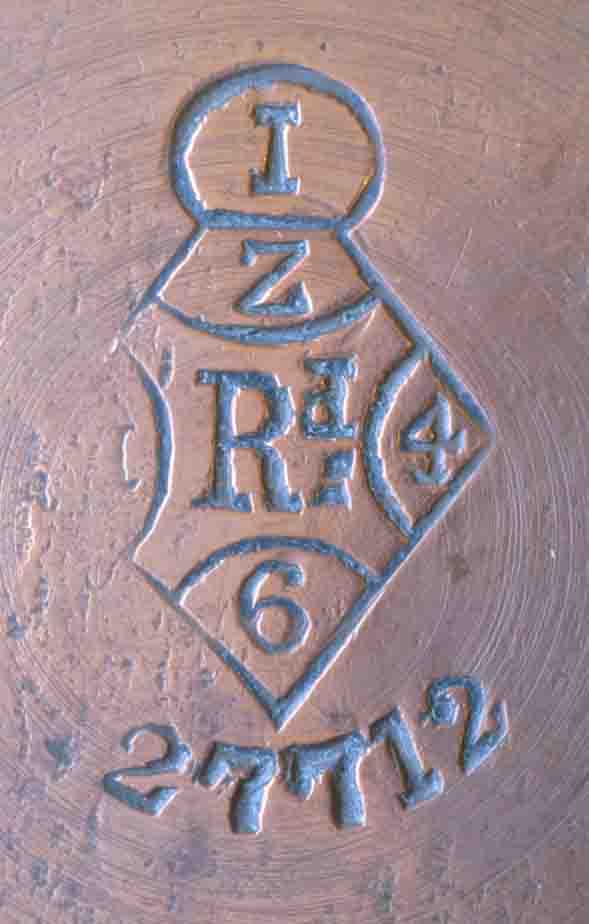
Table of Contents
Diamond Registration Marks (Lozenge Marks)Key to Diamond Registration Marks
Design Registration Numbers
Country of Origin
Purchase Tax.
Islamic Calendar
References
Dating of American Patent Numbers
Diamond Registration Marks (Lozenge Marks)
The Copyright of Design Act 1842 initiated the use of the diamond registration mark used to confirm that a design has been registered in Britain . This confirmed that a design had been registered and gave three year’s copyright protection. The diamond contained enough information to allow identification from the official records held by the Patent Office. There was a letter to represent the year so the first series ran from 1842 to 1867. Other letters identified the day and month of registration, the material and bundle number. By shifting the positions of the identifiers, a second series was started and lasted until 1883. The Patents, Designs and Trade Marks Act of 1883 rationalised the system and thereafter only a number series was used.
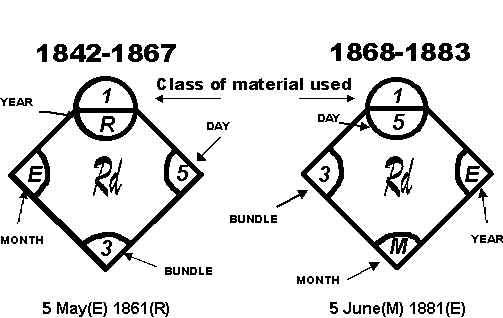
Key to Diamond Registration Marks
Letter |
First Series |
Second Series |
Months for both Series |
A |
1845 |
1871 |
December |
B |
1858 |
|
October |
C |
1844 |
1870 |
January |
D |
1852 |
1878 |
September |
E |
1855 |
1881 |
May |
F |
1847 |
1873 |
|
G |
1863 |
|
February |
H |
1843 |
1869 |
April |
I |
1846 |
1872 |
July |
J |
1854 |
1880 |
|
K |
1857 |
1883 |
November |
L |
1856 |
1882 |
|
M |
1859 |
|
June |
N |
1864 |
|
|
O |
1862 |
|
January |
P |
1851 |
1877 |
|
Q |
1866 |
|
|
R |
1861 |
|
August |
S |
1849 |
1875 |
|
T |
1867 |
|
|
U |
1848 |
1874 |
|
V |
1850 |
1876 |
|
W |
1865 |
|
March |
X |
1842 |
1868 |
|
Y |
1853 |
1879 |
|
Z |
1860 |
|
|
Design Registration Numbers
The system of registering designs with a specific number was introduced at the end of 1883. It superseded the previous 'Diamond' registrations. Where used, such Registered numbers (Rd No.........) give an accurate date for when a design was first produced. Such designs could then be produced in quantity for as long as needed or fashionable and numbers therefore only give the earliest date in which an object could have been produced. Since improvements in design have always been a driving force in the industrial societies, many of the numbers would only have been used for a few years and therefore do give a helpful guide.
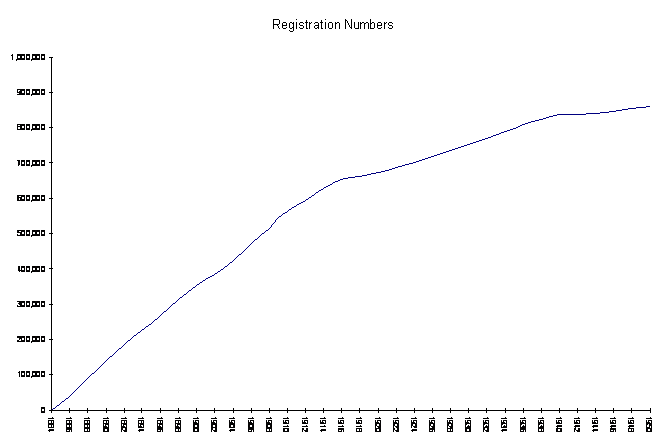
The numbers can be used to assess the first year of manufacture from these approximate figures showing the first numbers issued each year :-
Year |
From |
|
Year |
From |
|
Year |
From |
|
Year |
From |
|
|
|
1901 |
367,628 |
|
1921 |
676,491 |
|
1941 |
837,000 |
|
|
|
1902 |
380,979 |
|
1922 |
685,412 |
|
1942 |
838,000 |
|
|
|
1903 |
401,944 |
|
1923 |
691,571 |
|
1943 |
839,000 |
1884 |
1 |
|
1904 |
422,489 |
|
1924 |
695,944 |
|
1944 |
841,000 |
1885 |
18,993 |
|
1905 |
422,489 |
|
1925 |
705,943 |
|
1945 |
843,000 |
1886 |
39,547 |
|
1906 |
428,004 |
|
1926 |
716,386 |
|
1946 |
846,000 |
1887 |
61,207 |
|
1907 |
469,160 |
|
1927 |
723,430 |
|
1947 |
848,000 |
1888 |
87,266 |
|
1908 |
486,464 |
|
1928 |
725,899 |
|
1948 |
853,000 |
1889 |
111,664 |
|
1909 |
516,375 |
|
1929 |
740,459 |
|
1949 |
857,000 |
1890 |
140,481 |
|
1910 |
533,561 |
|
1930 |
741,336 |
|
1950 |
860,000 |
1891 |
160,613 |
|
1911 |
546,084 |
|
1931 |
757,945 |
|
|
|
1892 |
183,259 |
|
1912 |
561,570 |
|
1932 |
767,110 |
|
|
|
1893 |
203,348 |
|
1913 |
585,707 |
|
1933 |
777,000 |
|
|
|
1894 |
223,861 |
|
1914 |
608,541 |
|
1934 |
788,000 |
|
|
|
1895 |
244,726 |
|
1915 |
627,887 |
|
1935 |
793,000 |
|
|
|
1896 |
266,237 |
|
1916 |
642,613 |
|
1936 |
808,000 |
|
|
|
1897 |
288,848 |
|
1917 |
651,079 |
|
1937 |
817,000 |
|
|
|
1898 |
309,956 |
|
1918 |
662,576 |
|
1938 |
825,000 |
|
|
|
1899 |
328,527 |
|
1919 |
665,728 |
|
1939 |
833,000 |
|
|
|
1900 |
349,120 |
|
1920 |
664,869 |
|
1940 |
836,000 |
|
|
|
(Dating of numbers derived from lists of files held by the British Library (http://www.bl.uk/collections/patents/designs.html#desnum) and The Public Record Office. Numbers after 1933 are taken from the graph below, plotted from PRO files. Other sources may vary.)
Country of Origin
From the passing of the 1891 McKinley Tariff Act, any products imported into the USA were required to show the country of origin. The word ‘England’ was used from 1891 to c1909. Thereafter ‘Made in England’ was used and this was gradually succeeded by ‘Made in Britain’. Manufacturers frequently applied these marks to all products rather than just those destined for export.
The 1860 Companies Act established 'Limited' companies. The use of 'Ltd' after a company name gained favour after 1880. The use of 'Trade Mark' dates any time from the Trade Marks Act of 1862 until the present.
Purchase Tax.
This was a sales tax levied first on the 19th October 1940 on all goods sold in Britain with a few exceptions such as food, 'Utility' CC41 furniture and trade tools. It followed from the budget of the 23rd July. Price lists produced thereafter frequently mentioned that purchase tax was, or was not, included. The government's idea was to discourage luxury goods during wartime and later post-war shortages. The tax rates were a fixed percentage of the wholesale price. Catalogues that do not mention purchase tax may well be pre- 1939.
Islamic Calendar
Islamic metalwork may be dated and if so it is likely to use the Moslem calendar. This starts in the year of Mohammed’s flight from Mecca to Medina in the Western year AD 622 and the years are based on the lunar calendar of 354 days. To convert and adjust for the number of days in the year, the Islamic script can be read for the year using the following number conversions:
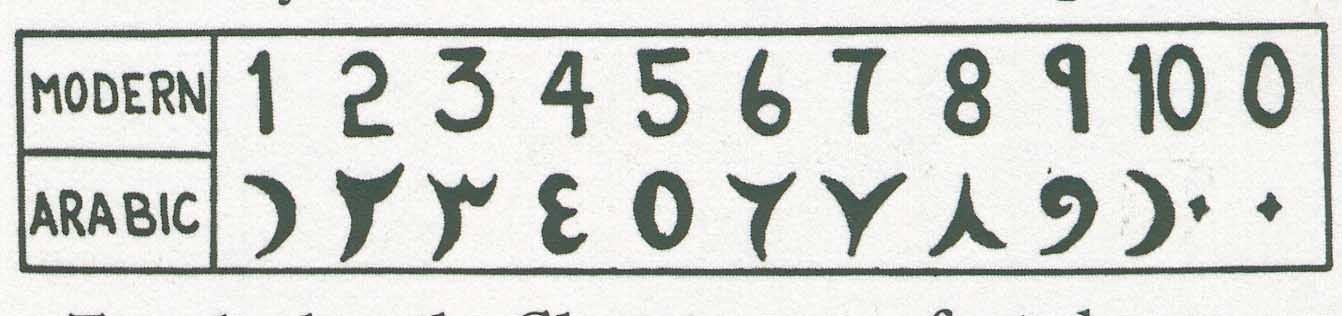
The conversion formula to use is:
YAD = 622 + YM - YM/33
where YAD is the Western year
and YM is the Moslem year
References
The data used has been abstracted from:
Jones, Ian, ‘Design Registration Marks’ Ironbridge Gorge Museum Information Sheet No 7, 1981.
http://www.patent.gov.uk/design/index.htm (page not now available)
The National Archives, Kew, Richmond, Surrey, TW9 4DU, United Kingdom
tel: +44 (0)20 8876 3444; fax: +44 (0)20 8392 5286.
Dating of American Patent Numbers
1859 22,477
1860 26,642
1861 31,005
1862 34,045
1863 37,266
1864 41,047
1865 45,685
1866 51,764
1867 60,685
1868 72,958
1869 85,503
1870 98,460
1871 110,617
1872 122,304
1873 134,504
1874 146,120
1875 158,350
1876 171,541
1877 185,813
1878 198,733
1879 211,078
1880 223,210
1881 240,373
1882 254,836
1883 269,820
1884 291,016
1885 310,168
1886 353,494
1887 355,291
1888 375,720
1889 395,306
1890 418,665
1891 443,987
1892 466,315
1893 488,976
1894 511,744
1895 531,619
1896 552,502
1897 574,369
1898 596,467
1899 618,871
1900 640,187
1901 664,827
1902 690,385
1903 717,521
1904 748,567
1905 778,834
1906 808,618
1907 839,799
1908 875,679
1909 908,436
1910 945,010
1911 980,178
1912 1,013,095
1913 1,049,326
1914 1,083,287
1915 1,123,212
1916 1,166,419
1917 1,210,389
1918 1,251,458
1919 1,290,027
1920 1,329,352
1921 1,364,063
1922 1,401,948
1923 1440,362
1924 1,478,996
1925 1,521,590
1926 1,568,040
1927 1,612,790
1928 1,854,521
1929 1,696,897
1930 1,742,181
1931 1,787424
1932 1,839,190
1933 1,892,663
1934 1,941,449
1935 1,985,878
1936 2,026,516
1937 2,066,309
1938 2,104,004
1939 2,142,080
1940 2,185,170
1941 2,227,418
1942 2,268,540
1943 2,307,007
1944 2,338,081
1945 2,366,154
1946 2,391,856
1947 2,413,675
1948 2,433,824
1949 2,457,797
1950 2,492,944
1951 2,536,016
1952 2,580,379
1953 2,624,046
1954 2,654,562
1955 2,698,434
1956 2,728,913
1957 2,775,762
1958 2,818,567
1959 2,866,973
1960 2,919,443
After