Three Wise Monkeys
(c) Antique Metalware Society
Small extracts can be used with acknowledgements to 'Oldcopper.org' website.
Helpful comments are very welcome.
Brassware featuring the three (or four) Wise Monkeys
When produced in brass it is now normal for the monkeys to be bald on top. This is not a sign of old age – just a pragmatic way of fettling the casting. Only the very best models will have had their hair scribed back in to place by craftsmen.
The general rule used to be that, the better detailed the monkeys are, the older is the product, even though some detail may be lost over the years through enthusiastic polishing. Now there are better casting techniques available that give much better detail in most modern versions. The smaller models are frequently solid, larger ones are cast hollow. It is very rare for makers’ marks to be evident.
Amongst many variations, some recent productions have a fourth monkey in the group. This one is called ‘Do no evil’ and is reported to have been used in support of AIDS awareness campaigns.
The classic Japanese depiction Buddhist Tendai uses their macaque monkey, also called the Japanese Snow Monkey as the model for their three wise monkeys. Modern representations may be more free-lance.
Beware modern highly-detailed monkeys that look too good. They may be zinc diecastings that have been plated and patinated to look like brass or bronze.
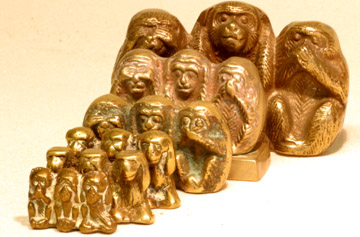
Three Wise Monkeys are a favourite subject for an ornamental brass paperweight. Their presence on a desk, window sill, or shelf can give cause for thought as well as pleasure. They come in several versions and a range of sizes. The popular image of the three wise monkeys can be taken as the ability of the disciplined mind to avoid evil. Alternatively, ‘Hear no evil, Speak no evil, See no evil’ may be said of people who just don't want to be involved.
The inspiration for most monkey groups comes from a carving above the portico of a 17th century temple in Japan called the Nikko Toshogu Shrine which includes a carving of the three wise guardian monkeys in a representation of a sacred stable. In Japanese 'don't see, don't hear and don't speak' (loosely known as 'see no evil, hear no evil and speak no evil') is translated as 'mizaru, kikazaru, iwazaru'. The word for monkey 'saru' sounds the same as the verb-ending 'zaru' (which means 'not') so the origin of these famous monkeys may be a Japanese play on words. (As additional information, ‘I see nothing, I hear nothing and I say nothing’ are, in Japanese: ‘mimai, kikumai and hanasumai’) (Ack.: Emil Schuttenhelm)
The basic idea of the three monkeys was introduced to Japan by a Buddhist monk of the Tendai sect from China, probably in the 8th century A.D. This was probably passing on knowledge gained from Indian Buddhists. In Japan, the monkeys were at first always associated with the blue-faced deity Vadjra, a fearsome god with three eyes and numerous hands. Their characteristic gestures of covering their ears, eyes and mouths with their paws were a dramatic pictorial way of conveying the command of the god.
(The symbol of the three monkeys forms part of a "folk belief/practice" in Japan called "koshin". In the night of "koshin"people congregated and stayed awake until dawn. They were praying to a god called Shuomen Kongo, a fearsome creature with usually six arms, similar to the deity Vadjra known from Indian Buddhism. By staying awake people hoped to avoid that their bad deeds were reported to the heavenly god. The three monkeys usually can be seen on paper scrolls that were used in the ceremony, whereby the role of the monkeys is to be understood as messengers (both ways). But some temples also show 3-monkey statues and in rural areas in Japan many "koshin" stones (koshin-do) still can be found . The first record referring to the koshin belief is by a celebrated Japanese priest called Ennin, also named Jikasu-daishi. He visited China (Tang Dynasty) and witnessed "koshin" practice there on November 26, 838. He wrote that he observed a practice similar to that of Japan.
Ack: Emil Schuttenhelm)
The monkeys appear in a wooden carving at the seventeenth century Toshogu shrine in Nikko, Japan. The shrine is the mausoleum of the shogun Tokugawa Ieyasu, and the three monkeys are sometime said to be the guardians of the stables. The "three wise monkeys" or three mystical apes ("sambiki saru") are the attendants of Shuomen Kongo, sometimes also Sarutahiko or Koshin. They are (1) Mizaru, covering his eyes, who sees no evil; (2) Kikazaru, covering his ears, who hears no evil; and (3) Iwazaru, covering his mouth, who speaks no evil. The source that popularized this pictorial maxim is a carving over a door of the Sacred Stable at the famous temple in Nikko, Japan (carved in the 17th Century). However, the maxim probably originally came with Buddhism from India via China in the 8th Century (associated with Vadjra who taught that if we do not hear, see or speak evil, then we will be spared evil). The “fourth” ape is a recent invention and may be seen occasionally in humorous netsuke as “do no evil” (“Shizaru”). Very occasionally a set may be made with five monkeys.
Thanks to Emil Schuttenhelm for very helpful comments. He has two excellent websites, one at: http://www.three-monkeys.info , a very comprehensive homepage, totally dedicated to collecting the three wise monkeys that hear, see and speak no evil.
His other homepage which was made for Japan is also very interesting: http://www.kcn-net.org/koshin/sanen/index.html
Three monkey collectors in Europe and in the USA meet on a regular basis. These are unique opportunities for No Evils enthusiasts to meet with fellow collectors and to exchange information and duplicates. For further details: http://www.three-monkeys.info/3mmeetings/
The next Collectors meeting in Europe can be found on line
The next conference in the USA will be from 23rd - 27th May 2013 in Albuquerque, New Mexico.
News from the Three Monkeys World
Also see http://www.thethreemonkeys.com/
When made in Brass, the wise monkeys are generally cast to shape. So far no fabricated monkeys have been found. The designers have to consider the production method and for most sets have opted to have their protégés cast in moulds that are split between front and back sections. The tops of the heads are on the parting line which has to be smoothed off and often leads to the baldness mentioned earlier.
There seems to be freedom of choice of the order in which they are positioned. For this page they are grouped into common order, described from left to right, and then classified by height.
The Gibraltar macaques are the only monkeys that live freely in Europe and are of the same family as the Japanese macaques. Since they are such a strong symbol and tourist attraction there are many souvenirs on sale. Generally they are similar to others but may have 'Gibraltar' incised or printed.
See - Speak - Hear No Evil
This series of sizes are all modelled sitting closely together which makes casting the metal much easier. It is understood that the patterns for the models are often made of lead and that as these wear, so the detail shown in the castings diminishes. These range in width from 33 to 95mm (1¼" - 3¾").
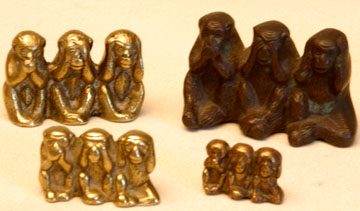
Speak - See - Hear No Evil
The largest of these has been given a bronze patina. It is 3" (75mm) wide.
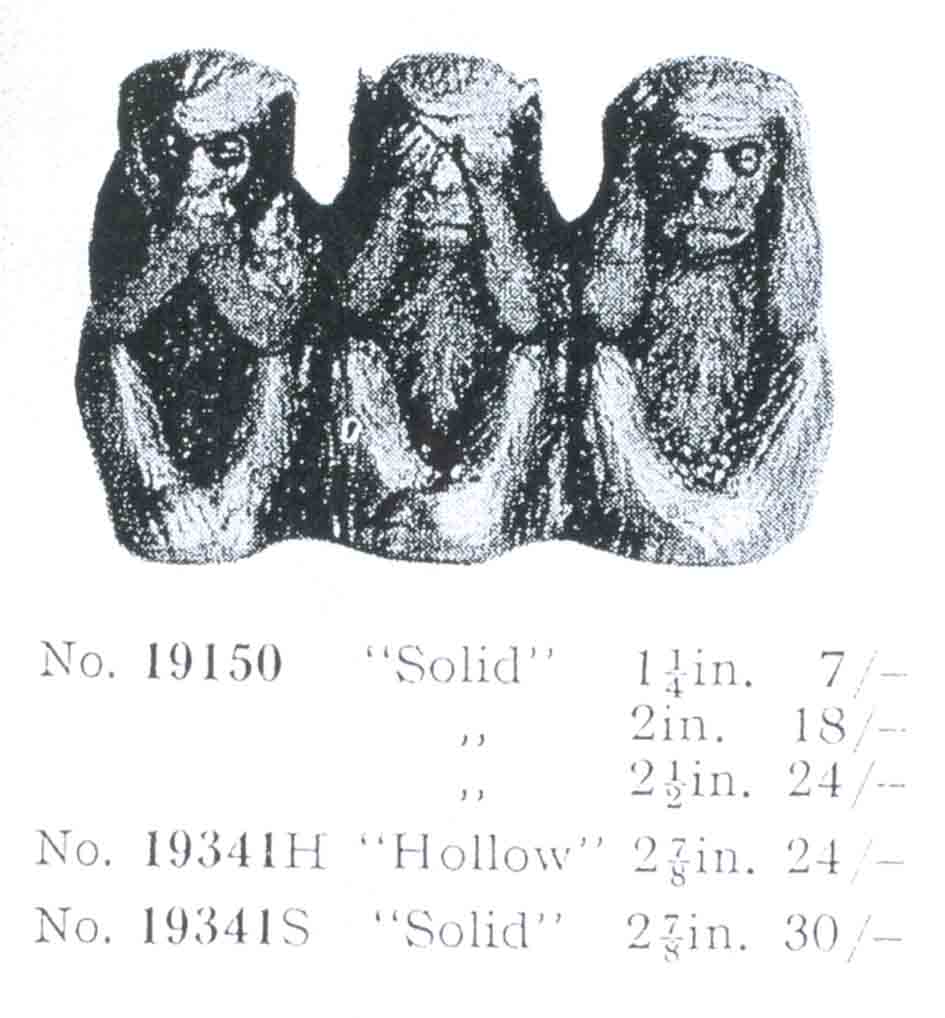
Shown in their catalogue of products in 1932, Pearson Page Jewsbury Co. Ltd. listed the three monkeys in a variety of sizes from 1¼" to 2⅞" (31-73mm) in width. The smaller models were cast solid and the larger size was also available as a cheaper hollow casting. The wholesale prices ranged from 7/- (shillings) per dozen upwards.
(20/- = £1 in old money and at that time there were US$4 to the £).
Hear - See - Speak No Evil
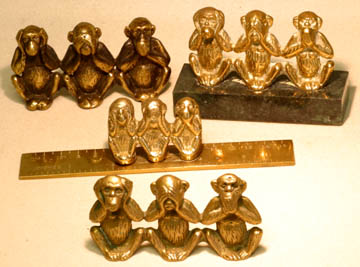
These are all modelled with just elbows and knees touching. The central ones are not just intelligent looking ornaments - they act as a handle to a useful ruler/straightedge/paperweight.
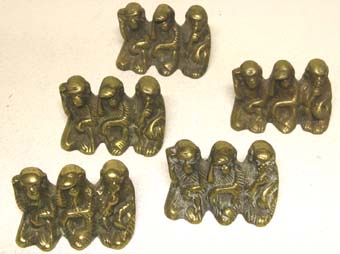
These all look much the same at about 55mm (2") high but there are differences. Obviously the sharpness of the casting varies from one to another. The three on the right are all hollow and weigh about 200g (7oz). The one top right is hollow but thick walled and weighs 274g (9.7oz) and the bottom right one is a solid heavyweight of 434g (15.3oz). Around 1933 they were in the Pearson-Page-Jewsbury, Birmingham, catalogue as features on bookends.
Speak - Hear - See no Evil
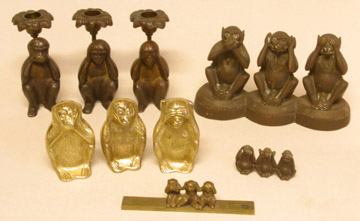
This is a less common grouping so has been augmented by two sets that are freestanding and can be placed in any order. On the left at the back are a set of candlesticks with wise monkey bases.
The set on the right are on a stand that is 215mm (8½ ") wide.
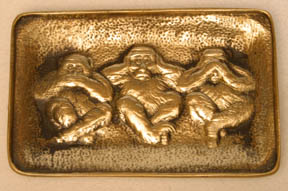
This 5" (125mm) wide tray was in the Peerage catalogues during the 1930s and again in the 1950s as No 19497 priced at 16/- per dozen wholesale.
Four Wise Monkeys
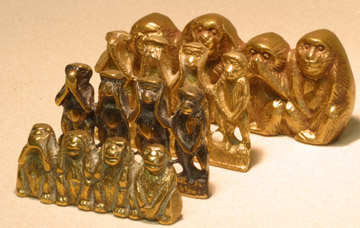
The order of the first three monkeys varies but 'Do No Evil' is always on the right.
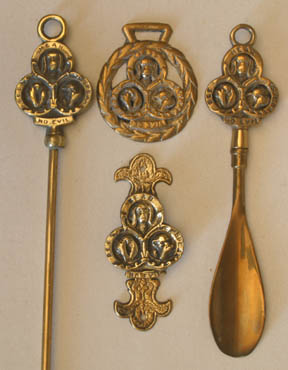
Toasting Fork, Horse Brass, Shoe Horn and Knocker
All based on the same arrangement surrounded by the legend: 'See, Hear, Speak No Evil'.
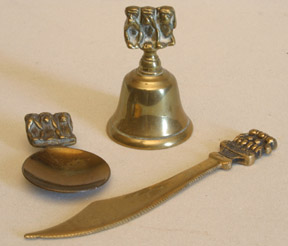
Bell, Tea Caddy Spoon and Paper Knife
The bell and spoon are by 'Peerage' (Pearson Page Jewsbury post 1946), the paper knife is from Turkey.
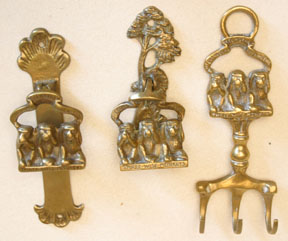
Door Knockers and a Coat Hook
Two Peerage bedroom door knockers from the early 1930s and a triple hook, all based on a 'Speak-See-Hear No Evil' model with 'Three Wise Monkeys' on the flat bar and the top banner bearing the legend 'Speak no evil, See no evil, Hear no evil'. The centre knocker bears the Design Registration number 723111 of 1926.
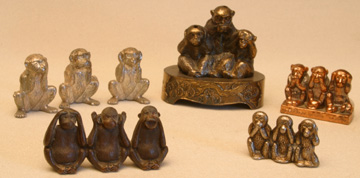
Neither Brass nor Copper
These might make a monkey out of the brass buyer. The one on the right is copper plated plastic, the others are plated zinc diecastings. They are lighter in weight than brass castings and a scratch test on the underside shows white metal.
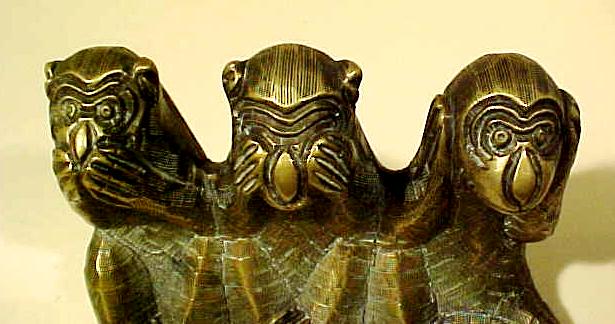
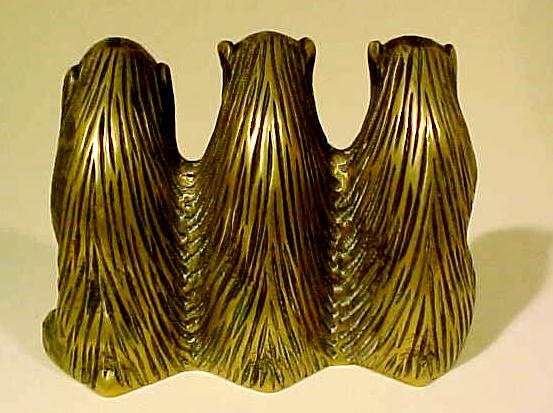
Above are illustrations of a set of three monkeys owned by Emil Schuttenhelm. The detailing shows great attention to finishing given by the craftsmen. (Photos by Emil Schuttenhelm).
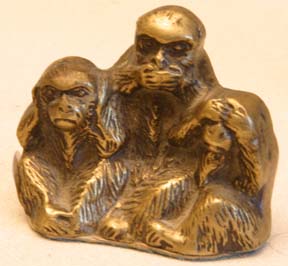
An unusual set where the central monkey is standing.
http://www.three-monkeys.info/1/blogeng.htm
A