Surface Finishing Cleaning polishing and Laquering Copper and Brass
(c) Antique Metalware Society
Small extracts can be used with acknowledgements to 'Oldcopper.org' website.
Helpful comments are very welcome.
Table of Contents
CleaningChemical Polishing
Hand Polishing
Tips
Machine polishing
Lacquering
Proprietary Finishes
Before polishing an item, check whether it has an old, natural patina that should not be destroyed forever. Then read on.
The colours of clean polished metals, especially copper and brass, are a major attraction. The deep glow of a good polished finish keeps a room or, better still, a whole house looking happy.
Before dealing with ways in which a good finish can be obtained and maintained, the point must be made that old copper that has acquired a patina with age may be best preserved by keeping the patina. Once centuries of patina have been cleaned off, that distinguished deep dull brown cannot be regained. For some items, the loss of a patina will reduce the perceived value significantly.
Cleaning
Cleaning can be carried out chemically, by the use of abrasives or with a polish that combines both. Pickling clean in an acid solution can be used with great care but is not recommended in domestic environments. ‘Bright dip’ solutions are available from specialist suppliers and the formulae available in technical literature. Recommended precautions for protection of eyes, body and environment should always be observed.
Abrasives must be used with very great care if a final mirror-finish polish is eventually needed. The coarser the abrasive used, the more effort will be needed to restore a polished finish. If abrasive papers must be used, fine and very fine grades of silicon carbide paper are needed, well lubricated with ‘wet’ water (water/detergent), white spirit or paraffin (kerosene) to keep the copper dust from clogging the paper. If it is necessary to start with a medium or fairly coarse paper, obtain an even finish in one direction. Using finer paper, rub at right angles to the previous scratches until they all disappear. Finish with finer paper at a different angle and the surface will then be ready for polishing. This technique prevents ‘tramlines’ caused by coarse abrasive re-appearing during final polishing. Remember that the more the paper has been used, the blunter are the silicon carbide particles. Always use old paper for the final finish.
Proprietary cleaners branded for cleaning up the outside of copper cookware normally have to contain powdered abrasive to make them effective. They will help get rid of flame blackening quickly but the abrasive is too coarse to lead to a good polish.
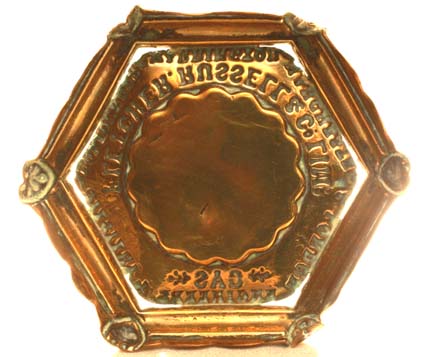
Below is a view from underneath a penholder base that has been polished away completely on the edges and corners. Light can be seen through the holes. Be suitably warned!
Use only a very gentle polish - rarely!!
Chemical Polishing
Common household and proprietary products are available that can be used to clean copper and brass without the need for muscular effort. These can be effective in the short term but leave a surface that is active and tarnishes again quickly. A long overnight soak is often best. As a means of cleaning out old polish from details, they can have their uses but the finish is never as bright as that given by mechanical polishing.
Citric acid (lemon juice)
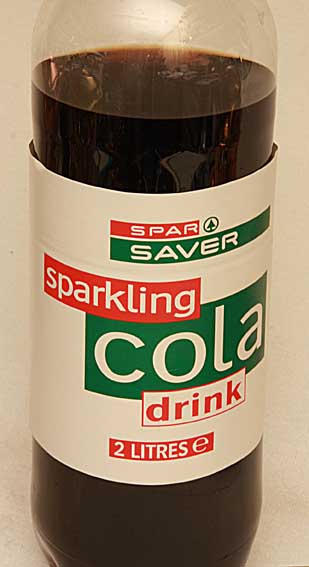
Phosphoric acid (fizzy drinks)
Acetic acid (vinegar and sauces)
Add common salt to the cleaner if something stronger is needed but always ensure that all traces are washed off brass as traces of chloride can be aggressive to heavily cold-worked metal.
The marks on this candlestick base are beyond normal 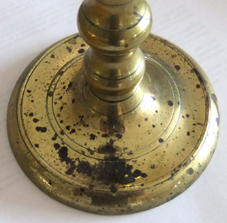 tarnish and will not be removed by normal light polishing nor mild solvents. Under the black marks you will find surface damage that is slight pitting corrosion. The use of domestic wire wool or fine abrasives will give a
 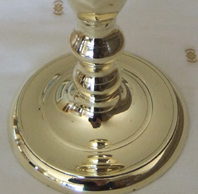 scratched finish that will need very heavy polishing to bring back to normal. Buffing on a powerful static polishing machine will be best, see below. A good metal finisher did do the job fairly quickly. (Photos by Trevor Farley)
Yes, it did come up well after professional polishing!
Hand Polishing
Hand polishing can be a very satisfying activity. When well polished, copper and brassware will smile back in a way that warms the heart! Polishing is an activity that stimulates the circulation successfully and can be a useful exercise undertaken indoors when outside activities are impracticable. It is an activity to be recommended when the results of a good meal might lead to an unhealthy easy-chair slump.
As part of the cleaning or polishing techniques, the use of metal polishes are long associated with copper and brass. Proprietary polishes usually contain a mild abrasive suspended in a chemically active medium. Strong smelling ones that contain ammonia etch away the metal for fairly fast action on plain surfaces. Milder cleaners should be used when fine etched detail is present since frequent cleaning with conventional polishes removes pattern surface detail in time.
The other main constituent needed is of course, elbow grease. Good pressure is needed when polishing, since this actually smoothes over the ductile surface of the metal and helps to obtain the required mirror-finish. This is much more resistant to further tarnishing than the active surface left by a chemical cleaner. Residue in crevices should be washed out with a toothbrush and detergent before the final polish.
Tips
· Select type of polish with care, see above.
· Generally start by washing off all dust - household dust includes abrasive particles that can cause severe scratches when picked up on a polishing cloth. Dried polish that has been left in nooks and crannies should also be washed out with as toothbrush, helped perhaps by the end of a soft wooden tooth pick.
· Use clean, soft polishing cloths. Old ones will have picked up abrasive particles. ‘Selvyt’ cloth is used by professionals.
· Use as little or as much polish as you need - plenty of polish may be needed to cut through heavy tarnish easily. If only a little is used there is less to fill nooks and crannies.
· Use a former, button stick or other simple jig if it will make life easier and prevent polish going onto surfaces such as walls or clothing where it is not wanted.
· On a large object do one section at a time, leaving the polish no time to dry before it is removed.
· Polish off with a clean soft cloth.
· Wash thoroughly any items that have crevices such as engraving, etching or tight corners that can fill with polishing residue. A nail brush or toothbrush and washing up detergent
Dry and final polish with a clean soft cloth.
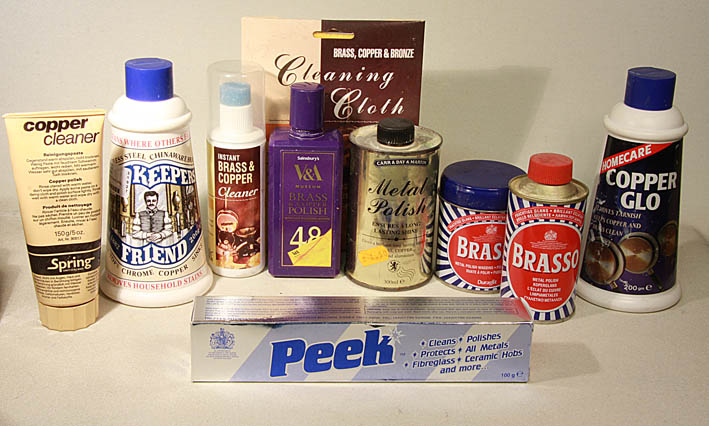
Machine polishing
The use of rotating mops and pads can be an excellent way of rapidly obtaining a good finish on copper and brass. Naturally, great care must be taken to ensure that objects are held steadily and safely, a good dust mask must be worn and a dust extractor used if the polishing debris is not to be circulated all over the workshop. Excellent results can be obtained using recommended mops and polishing compounds but experience is needed to obtain the best finish that leaves no smears of the black paste that the polishing produces.
Generally, for polishing rough materials use a stitched mop with medium polishing compound. For finish polishing use an unstitched mop and fine finishing compound. Take a pride in leaving no black smears of polishing compound. Some people finish polish by hand and therefore give the closest possible final inspection. Fine details and chains can be cleaned with jeweller’s rouge applied to very fine string or cotton.
After fine polishing a precious item, the lifetime of the finish can be prolonged by handling only when wearing cotton gloves. This avoids the oily acidic coating on the skin causing fingerprint stains.
Lacquering
To reduce the need for frequent cleaning, the surfaces of copper and brass can be lacquered. The surface of the lacquer gives a bright but shallow reflection clearly different to the deep glow of a good polish but is acceptable for much domestic hardware and electrical fittings. Lacquers used must be suitable for copper-based materials in order to inhibit tarnishing. They must be applied on surfaces that are scrupulously clean and free from oil or grease. Some lacquers, especially the basic cellulose type, allow tarnishing to take place under the surface of the coating.
Care should be taken to select lacquers designated by the manufacturers as suitable for use on copper, brass and other copper alloys that include a tarnish inhibitor such as benzotriazole or suitable alternative in their composition. Air drying lacquers can frequently be applied by brushing, dipping or spraying. A more viscous grade may also be available to give a thicker film and greater protection.
New products such as electrical switchplates that are intended for interior service in active domestic environments are frequently treated with stoving lacquers that give a very durable finish. Melamine formaldehyde is a fast curing material with good toughness and resistance to water. Melamine acrylic lacquer is even better, being more resistant to abrasion and completely clear. Manufacturers recommendations for application and safety should always be followed.
Most lacquers are not suitable for prolonged exposure outdoors.
Interestingly, it has been suggested that one way of getting a good patinated finish is to coat a well-cleaned item with simple cellulose lacquer not intended specifically for copper or brass. In time a good chocolate brown film is said to develop underneath the lacquer film. Presumably it helps if the surrounding atmosphere is humid, as in a conservatory.
Proprietary Finishes
Makers of copper and brassware have supplied their products with a great variety of finishes. These are intended to increase variety and eye appeal initially and through the lifetime of the product. Many have survived over a hundred years or more of service without maintenance. Others, such as the patina on statues erected in the outdoors, need periodic cleaning and re-protection. Early finishes were made up by the makers and frequently the formulation was kept a trade secret. Latterly they have been obtained from proprietary suppliers.
When placing orders with the manufacturers, retailers specify the required finish from the catalogues. To give an idea of the finishes available, underneath are listed the ordering codes of one Birmingham manufacturer:
P Polished (Brass)
SF Satin or Dull Gold Finish
AB Dark Bronzed, Polished Relief
GB Bronzed Old Brass
HP Half Polished (Old ‘Cleaned up’ Brass)
AC Oxidised or Antique Coppered (on brass)
ACB Oxidised or Antique Coppered (Dark Blue Ground) (on brass)
OS Oxidised Silvered (using real silver plate)
IOS Imitation Oxidised Silver
C Polished (copper)
CB/6 Florentine Bronzed and Relieved
OC Bronzed Old Copper
BMA Bronzed Metal Antique
EB Electro Brassed steel
ACI Antique Coppered steel
After